In this lecture, we looked primarily at why certain advertisments are memorable for certain types of people and why.
The task was to look at a number of different advertisments and try to remember as many as possible, stating our first recalled advert first.
One of the main differences found between who remembered what, was gender differences. It seemed that males repeatedly recalled the adverts that provided humour, and it seemed that most of the adverts with the funny twist were aimed at males promoting products and services for men. The females however tended to remember the adverts with celebrity endorsements, adverts for products such as perfumes. The advert for this Paco Rabanne fragrance, does not convey an extremely famous celebrity in their advert, (such as Beyonce beinf the face of Tommy Hilfiger's True Star) but it does draw your attention to the advert through other means.
Adverts that successfully use colour in their adverts can really catch your eye if contrasting is used effectively. The advert shown here has immediatly made the perfume stand out in the foreground by using the neon streaks of purple to intensify the name of the product. Because the rest of the advert is black and grey, this purple streak really amplifys the product being presented.
The senses are also used widely in advertising. Visual and touch are the two senses that most stand out in the paco rabanne advert, and this applies to many other adverts. It is strange however to notice that the sense of smell isn't addressed in perfume adverts, a sense that is vital to the success of perfumes and aftershaves.
A link was also found between the amount of analysis an advert required to understand the product being promoted. It seemed the more complicated the advert's underlying message, the less less likely the males remembered them.
There is also a theory on the primary and recency effect. This theory suggests that women would tend to remember the first advert they see whereas the men are more likely to remember the last advert they see. This theory is applicable to many other visual tests as well as the intake of words or knowledge etc.
"A persons unique make up which consistently influences the way the person responds to his or her environment."
"Those inner psychological characteristics that both determine and reflect how a person responds to his or her environment." Schiffman and Kanuk (2004)
...has an external aspect (how someone interacts with someone else), an internal aspect (a combination of the person's values and attitudes), a dynamic aspect (how someone behaves when facing a new situation; social adjustments etc) and a consistent aspect (the person's characteristic style). Hollander
...is made up of an Id, an Ego and a Superego. The Id is the selfish part of the person, it is the part of you that wants to maximise your pleasure. The Superego is the part of you that is conscious of the society and it's rules. and the Ego is the part that mediates between the Id and the Superego, it is the part that creates a balance between the two opposites. Freud.
...develops from the level of anxiety felt at being a depedent child. Horney came up with 3 personality types dependent on the level of anxiety, these are; Compliant, Aggressive and Detached.
This image comes from Aaker's brand personality framework, his belief is that by choosing the category that most suits you, you can determine your main personality traits.
"The beliefs a person holds about his or her own attributes and how he or she evaluates those qualities." Solomon (1999)
"People see themselves as they imagine others see them." Solomon (1999) This quote suggests the importance of people's personal belongings. The quote suggests that people can assess others through merely looking at their possessions. Therefore, when it comes to people buying a certain product, they may not only be thinking about whether they like it or not, they may also be thinking about what others may think of that product and what assumptions people may make about you from buying such a product.
"The individual as perceived by that individual in a socially determined frame of reference." Newcomb
...does not necessarily reflect reality. It may not matter what the actual facts about that person are, it is what the person believes that makes self concept. This can account for people that suffer with eating disorders such as anorexia and bulimia; the person may be morbidly skinny, but they see themselves as overweight.
The advert shown below is all about self concept.
...is derived from social comparisons with others. James (1980) This is why there has been such controversy in regards to the amount of extremely skinny models being advertised in magazines promoting beauty, leading to a rise in young women and more recently young men suffering from eating disorders. If you have nothing else to compare yourself to but an unrealistically beautiful model with no faults whatsoever, then your self concept and self esteem will be dramatically affected. This could be either in a positive or negative way, and this is why advertising is so important, not only for promoting a product, but also for shaping how its audience react.
The larger the gap between the ideal self and self image, the lower the self esteem. The further away you want to be from what you actually are, the unhappier you are likely to be, hence your self esteem being dramatically lower. Dove have created a campaign for real beauty. This is to try and boost women's self esteem that are dampened by the unrealistic airbrushed and digitally edited faces and bodies in the media used to advertise beauty.
The majority of participants compared themselves with models in advertisements; comparisons were both general and specific. Most participants mentioned that their first reaction, when looking at advertising images, was to study the size of the model's body. Different models were envied for a variety of reasons such as their weight or height, their beauty or their age. Some younger respondents (aged 25-29) envied the models for their very thin figures:
'You look at the models and think...yeah, I'd like to be that thin...you think yes, I'm going to start that diet next week. It's like...you'd like to look like that.
By looking at this article, you can see just how much of an impact advertising can have on their target audience.
This lecture introduced us to the importance of segmentation when trying to identify a target audience for a certain product or service. We looked at ways in which things can be segmented, and the list is endless. Some of the most common ways to segment a market seem to be gender, age, social class and demographics etc. Once you have this information about a person, it is then easy to go on and predict more about their lifestyle, therefore being able to target them as your market audience.
“based on the observation of evolution of demand and represents a more precise and rational adaptation of the product and the marketing effort to meet customer or user demands” (Smith 1957)
“the subdividing of a market into homogenous (or similar) subsets of customers, where any subset may conceivably be selected as a target market to be reached with a distinct marketing mix." (Kotler 2000)
We looked at the changes of product variety through from the Victorian times where for example, carbonic soap was used as a multi cleaning product through from washing hair to cleaning washing. The choice we have in supermarkets now is endless; the industries are now acting on the increasing demand of their customer, in providing a basic product evolved in many different ways. In particular we looked at shampoos and toothpastes, being able to identify at least 15 for each. Are all these different types of product needed? Probably not. But in today’s society where everyone is so anxious about being perceived in a positive way, marketers can take advantage of the insecurities shown by their target market, and make their consumers THINK they need their new improved product, and so the cycle goes on. Maybe shampoo for curly hair works no differently to that of shampoo for straight hair, but it is what the marketers make the consumers believe that matters, and this is how new products will continue to be produced year after year.
We looked at the work of Doyle and his theory on STP Marketing. S = Segmentation, T = Targeting and P= Positioning. All 3 of these stages are vital for a product or service to be successful. It is easy to think of the process as a pizza. The pizza will be cut into slices; these represent the different segments of the market. You then choose a slice; this slice is your chosen target segment...the section of the market you will be aiming your product or service at. Finally, you choose the best part of the slice, and this part is the desired position; the area that is the best place to get your product or service out to your market.
We also learnt the importance that segmentation plays in marketing. By choosing your target market, you can match the product or service in a better suited way, therefore matching more closely to the needs of the customer. If this is done well then profit levels will become hugely enhanced. If the product or service is matched well to the customer needs, this could lead to retaining customers through loyalty to that product or service. Finally we looked at how segmenting markets makes it easier to get the message that you want to give out in a clear and understood way. If you did not segment your market and sent out the same message to a variety of different target audiences, the message could be perceived in the wrong way leading to an unwanted result.
After learning about the theory behind segmentation, we then went on to do a practical task. This was to look at a food shopping receipt and try to analyse what kind of a person the consumer was. Laura and I took the longest list so purely from this decided that it was shopping for a family. We had to draw a word person to show as much as we could about the person, and when revealed the true identity, we had almost got it spot on! Just goes to show how much information you can get about someone from such a small amount of information. This is the same kind of basis marketers need to work from. They get their snippet of information about the target audience and build on it from there. For example, if you find out someone has a W1 postcode you can automatically work out what their lifestyle is likely to be.
Below is an advert for the new lynx chocolate, the advert is very clearly aimed at a carefully segmented market; the young male wanting to attract female attention.
This session was aimed to put the theory of perception into practice through group experiments. The experiments look at the perceptions you can make through taste, smell, touch and sight. The first experiment was a taste test using diet Pepsi and diet coke; 8 cups of each drink were issued to 4 girls and 4 boys to make the test as fair as possible. Before trying the drink, everyone had said that they preferred coke to Pepsi, yet when trying the drinks anonymously, everyone sided with the diet Pepsi over the diet coke, thinking that the Pepsi was the coke. This experiment shows that maybe people think they prefer the coke simply because of how they perceive the brand.
The second experiment was done with 3 different types of chocolate. The team leading this experiment were looking for the nicest chocolate in order from best to worst as well as the order of pricing. Because Britain is a nation with a very sweet tooth, it was not difficult for all the tasters to say not only the order from best to worse, but could also identify the brand of each chocolate. The 3 types were Cadbury’s Galaxy and a supermarket value brand. This shows that the brands have evolved their product to stand out from all others, not only through taste, but also through shape (with galaxy’s recent shape of chocolate being very distinct).
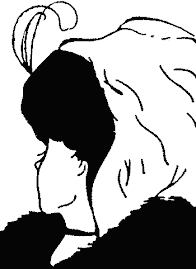
The next experiment was run by Laura and I. We had a sheet of paper with various images on; all of which could be interpreted as different images dependent on the viewer’s perception. The first image was of the image in my above blog...do you see the young or old lady? Out of 8 participants, 4 boys 4 girls, 7 of them saw the young lady with only one girl seeing the older lady. We also had an image of an elephant with a deceptive number of legs. All four boys simply said 4 legs without thinking or analysing the image, whereas all 4 girls spent a lot of time trying to decipher each leg, all coming up with an answer of 5. This adds to my theory from the last blog that males think in a much more simple way than females...in the real world elephants have 4 legs, therefore the image must have 4 legs. Some of the images proved a varied mixture of perceptions, with up to 4 different images seen. This experiment helped to show how subjective image perceptions are, and therefore how careful advertisers have to be in order to get their target audience to perceive the message portrayed in the way they want them to.
The next experiment was to try and identify various shampoos through smell and touch. The girls taking part in the test were overall the best at identifying certain shampoos such as dove and L’Oreal elvive, this was partly through smell and through feeling the shape of the bottles. Another shampoo that was put into a stereotype by all participants was a shampoo for males; this was identified by the type of smell and through the masculine shape of the bottle. Again this test shows the importance of how you market your product, Dove has done this well as almost all of the girls taking part identified it through its unique curved bottle.
The final experiment was done with men’s aftershave. There were 3 bottles disguised and lettered A B and C, the aim being to state the favourite through to least favourite and in order of price range. The results showed that the least likes scent was in fact the most expensive and the most liked scent was the cheapest. This result was consistent from all participants. One of the brands was also identified through scent alone, showing how important it is for marketers to get their product right before it becomes associated with a brand that it could potentially destroy if it was done badly.
Perception defined by Wilkie is "the process of sensing, selecting and interpreting consumer stimuli in the external world". On a broader scale, Schiffman and Kanuk sum up perception as "how we see the world around us"; this definition shows how perception is an extremely personal interpretation. The image above demonstrates this point...some may straight away see an old lady, others may not be able to see this at all but see a young lady looking over her shoulder.
In todays lecture, we started looking at the differences in how people perceived situations, it was extremely interesting, especially looking at the differences in perceptions between genders. The conclusions of various activities produced results that would suggest women have a lot more in depth perception levels, whereas men are far less analytical of situations, and only make perceptions on what meets the eye. One activity that showed strong trends of the above results was an activity involving allocating appropriate names for paint colour charts. The most prominent result was where the girls called a certain shade "mediteranean sunset" and the boys went for plain "orange". This strengthens the point that girls tend to be a lot more analytical and perceptive than boys.
We also looked at "The black box model" or the model of buyer behaviour. The assumption is that you start with the marketing stimuli, (the 4 P's or "the marketing mix"...product, price, place, and promotion) which is then considered with other external stimuli such as the individuals perception on economics, politics and culture etc. The next stage of the model is where the buyer's characteristics and decision process influences the response, before finally all the inputs are added up to form a final decision.
Another theory analysed was that of Kotler and his Buyer Decision Process. His theory states that it is compulsory to pass through 5 stages when making a decision about purchase. The first step is the need for recognition. If the product is not recognised then the process can go no further. The second stage of the model is the information search. This may be done either consciously or subconsciously and is where you decide whether or not the product being considered is good; it can be done by looking back at past experiences and knowledge of the product. The third step is evaluating any alternatives, this would be to decide whether you have got the produc most suited to your wants and needs. The next step is to decide whether or not you want to make the purchase. This may be influenced by factors such as the standard of the product...are you only satisfied with it, or are you delighted by the product? Finally is the post purchase behaviour. This would occur after the purchase has taken place, with the behaviour being affected by how pleased you are with the result of the product.
Although Kotler states how important it is to pass through each and every one of these stages in order to be pleased with the outcome, it is not necessary in the case of impulse buying. Impulse buying is a purchase that you do not want or need to think about before deciding to get it, with impulse buying, the middle three of Kotler's steps are irrelevant.
So this is what it feels like to be a proper student! My first lecture on "Understanding the Customer" and I already have millions of thoughts and questions flying around my head! I now dont feel too bad about putting people into stereotypes withing the first 2 seconds of seeing them... I'm not the only one! We had a poor visitor in class today, standing there silently in front of us all, whilst we said exactly what we thought of her; from what car we thought she had to thinking she was a beauty therapist who loved horseriding! We were all completely wrong with our judgements...just goes to show you shouldn't judge a book by its cover. Despite probably embarassing the girl hugely, it was a laugh a minute for us making up her entire life history purely from looks alone.
We spent time studying the theory of Russell W Belk, the concept of "me" and "mine". The idea behind the theory was completely logical, if something of mine was lost or stolen that had any kind of value be it sentimental or monetary, I would be gutted! Chances are I could live without most of my belongings, never the less, I would still make a huge fuss! It is belongings that make a person into who they are. By losing something that belongs to us, it is like part of an identity being taken away from you.
We tried playing a game to test out Belk's theory by all bringing in anonymous belongings and sharing them amongst the group. The game involved trying to make perceptions about the owner of the items without actually knowing who they were. Some objects were extremely easy to match with the owner, proving the point that possessions say a lot about who you are. "You are what you have" is therefore in my opinion a very accurate statement.